

- Plan Your Visit
- Learn
- Give
- Collections


There at the Founding
 Back to Exhibits
There at the Founding
As the United States approaches its 250th anniversary, the nation continues to reflect on the long, unfinished experiment of self-government. Few families illustrate that continuity – and its complexities – more clearly than the Harrisons. Members of the Harrison family helped shape, challenge, and refine American governance from the colonial period through the nineteenth century, leaving a political legacy that still echoes in America’s 250th year.
The Harrison family’s roots in America stretch back to the mid-1600s, eventually taking firm hold in Virginia at Berkeley Plantation. As wealthy, white, enslaving landowners, the early Harrisons occupied positions of influence within Colonial America. Civic engagement became a defining family tradition – if not an expectation – spanning generations before and after independence. Their involvement helped establish political precedents that continue to inform American democracy as the nation marks a quarter millennium.
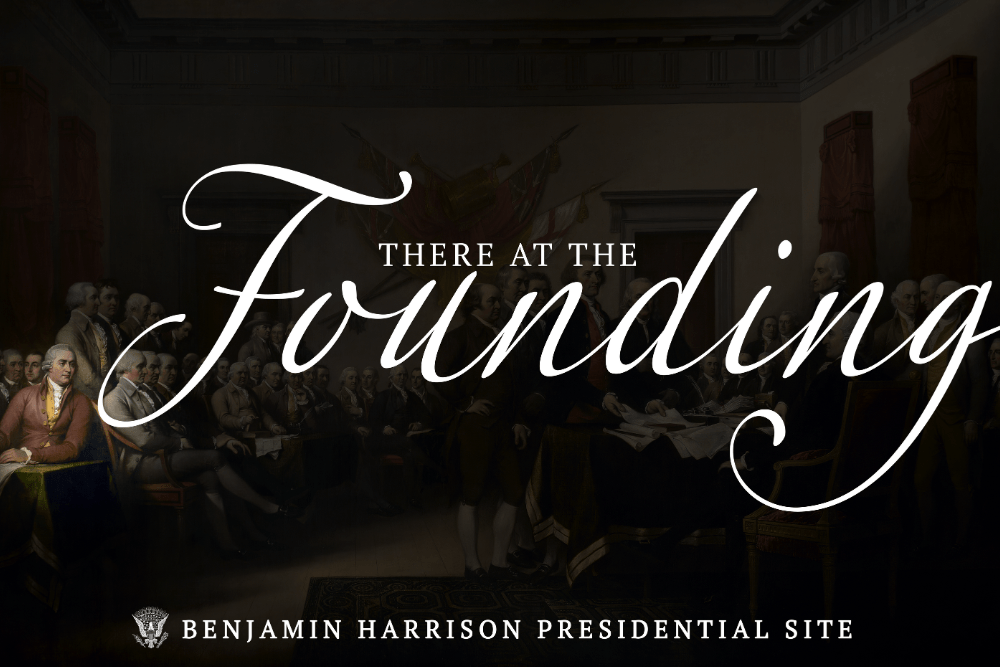
Benjamin Harrison V was a lifelong statesman whose career bridged colonial governance and revolution. He served in the Virginia House of Burgesses until the 1770s before joining the revolutionary cause. As a Virginia delegate to the First Continental Congress, he was selected on June 1, 1776, to read aloud Thomas Jefferson’s first draft of the Declaration of Independence while serving as Chairman of the House during debate. On July 2, 1776, he became one of the 56 signers of the Declaration. In later years, Harrison served multiple terms in the Virginia legislature and three years as governor. Near the end of his political life, he opposed ratification of the U.S. Constitution in Virginia, citing insufficient protections for individual liberties and excessive central authority. That opposition helped fuel momentum for the addition of the Bill of Rights – an enduring cornerstone of American freedom.
William Henry Harrison’s public life reflected a nation in motion. The youngest son of Benjamin Harrison V, he was only eight years old when his family home was attacked and its contents burned by Benedict Arnold, exposing him to the brutality of war at an early age. Appointed to military service in the Northwest Territory in 1791, Harrison became a central figure in America’s westward expansion, fighting Indigenous nations and later serving eleven years as territorial governor of Indiana. During this period, population growth triggered expansions of territorial governance and federal power. Drawing on military victories at Tippecanoe and Fort Meigs during the War of 1812 and a cultivated image of frontier leadership, Harrison secured the Whig presidential nomination in 1840. He won the election but died exactly one month into his term, leaving behind a lifelong commitment to what he described as the “true principles of government.”
Benjamin Harrison, great-grandson of Benjamin Harrison V, carried the family’s public service tradition into a modernizing nation. Unlike his forebears, he inherited little wealth and built his career through law, practicing in Indianapolis and upholding the rule of law as a near constant in his life. At the outbreak of the Civil War, Harrison was a young attorney serving as Reporter of the Indiana Supreme Court. He set aside his legal career to command a Union regiment, eventually earning the rank of Brigadier General. After the war, he resumed his legal practice and argued fifteen cases before the U.S. Supreme Court. As president, these experiences shaped his efforts to strengthen federal legal protections and expand personal liberties—reflecting a nation grappling with the meaning of freedom long after its founding.
Opening January 22, 2026, and featuring rarely displayed objects from the collection, There at the Founding examines how the ideals and, more importantly, the actions of these men influenced the evolving meaning of American freedom. As part of the America 250 commemoration, the exhibit invites visitors to consider how one family, across four generations, helped shape, test, and redefine the American political system, and how that system continues to evolve today.
“Let those who would die for the flag on the field of battle give a better proof of their patriotism and a higher glory to their country by promoting fraternity and justice.” Benjamin Harrison
Declare your Support

Share the life stories, arts and culture of your 23rd President

Renew your membership with us.

Support a legacy.
